
Getting to Turin - Flight, Train and Car
How do you get to Turin? Caselle Airport, high-speed trains from Milan, Paris and Rome, driving over the Alps, and getting around once you're there.
Contents
Turin sits in north-west Italy at the foot of the Alps, and there are three good ways to reach it from abroad, by air via Caselle or Milan, by high-speed train on Italy's fast rail network, or by car over the Alps. Which option makes most sense depends on where you're travelling from and whether you want a car once you're there. Inside the city itself, you won't need one.
Flying into Caselle
Turin-Caselle Airport (TRN) lies about 16 kilometres north of the city. The fastest way into the centre is the regional train (SFM), which has connected the airport station to Torino Porta Susa via lines 4, 6 and 7 (operated by Trenitalia) since December 2024, a journey of under 30 minutes. Frequency is still being built up; the goal is a 15-minute interval, though some gaps are currently still 30 minutes.
An alternative is the Arriva Italia airport bus (formerly SADEM), which runs into the centre and stops at, among others, Porta Nuova and Porta Susa stations. It runs roughly every 15 to 30 minutes and takes about 45 to 50 minutes. A single ticket costs €7.50 (online or from a machine), a return fare is available for €11.00, and a family ticket (two adults, two children) costs €23.00. A taxi for up to four people typically costs around €30 during the day and about €33 at night (22:00-06:00), plus possible surcharges for luggage or a fifth passenger.
Travelling via Milan
If there's no good direct flight to Caselle from your home airport, flying into Milan (Malpensa or Linate) is often the better option. From there, a high-speed train gets you to Turin in about an hour, more on that in the next section. Combining a Milan flight with the rail connection usually offers more choice and flexibility than the more seasonal, less frequent direct flights to Caselle.
By train
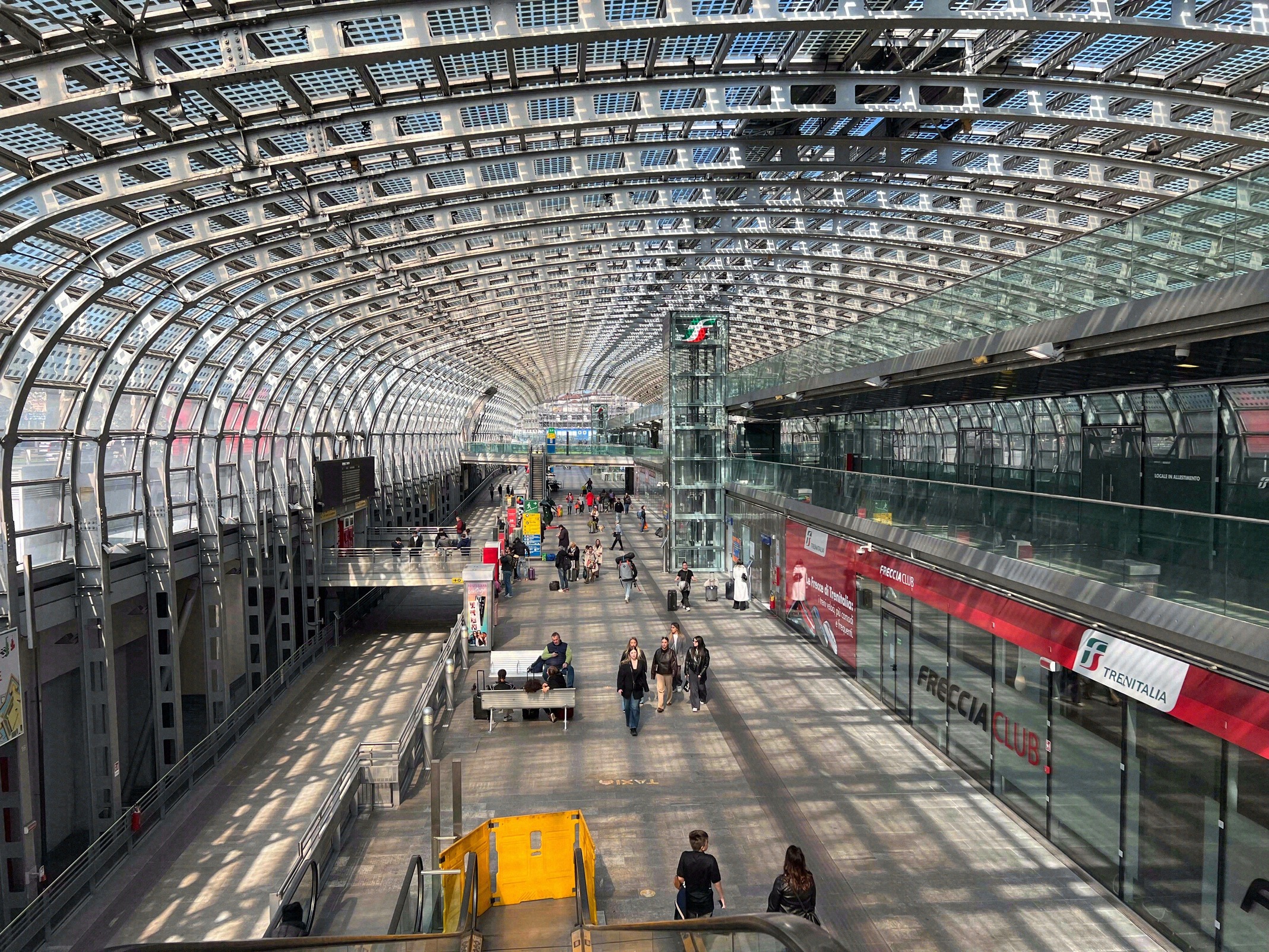
Turin is well connected to Italy's and Europe's high-speed rail network. The main stations are Torino Porta Nuova in the heart of the city and Torino Porta Susa, where most high-speed trains and the airport train stop.
- From Milan, around 33 trains a day run, most of them direct. The fastest Frecciarossa (Trenitalia) and Italo services cover the route in about 47 minutes, with an average of roughly 1 hour 12 minutes. Italo fares start from €8.90; booking close to departure pushes average prices well above that.
- From Rome, around 28 trains a day run, including 10 Frecciarossa services calling at Milan, Bologna and Florence. The fastest connection takes about 4 hours 10 minutes, with an average of around 5 hours.
- From Bologna and Florence, you're on the Frecciarossa backbone Turin-Milan-Bologna- Florence-Rome-Naples, which links Turin directly with both cities; the Bologna-Florence leg alone takes just 35 to 37 minutes.
You can book high-speed trains directly with Trenitalia or Italo, or through third-party platforms such as Trainline, Omio or Rail Europe. From Paris, take one of the three daily TGV INOUI (SNCF) services or a Frecciarossa; the route via Chambéry and Modane through the Maurienne valley takes around 5.5 to 6 hours, with early-booking fares from about €29 to €39. Note for 2026: engineering works in the Mont Cenis tunnel mean no direct Paris-Milan trains from 11 September to 9 October 2026; services are rerouted via Switzerland during this period.
Driving over the Alps
For travellers driving from Central Europe, the route usually runs via Switzerland or via Milan. From Munich, it's about 615 kilometres and roughly 6 hours 45 minutes, typically via the Gotthard or San Bernardino passes. Turin itself sits on several motorways towards Milan, Genoa, France (Fréjus tunnel) and the Aosta Valley.
Several costs add up along the way, so it's worth budgeting for them:
- Swiss motorway vignette: required for the Gotthard transit route. The 2026 annual vignette costs CHF 40 (around €45) and is valid from 1 December 2025 to 31 January 2027 - there's no day or week option.
- Italian tolls: a standard car pays around €9 per 100 kilometres.
- Alpine tunnels: the major tunnels have their own toll. A return trip through Fréjus or Mont Blanc costs around €68.60 each.
Which route is cheapest from northern Europe depends heavily on traffic and daily pricing, so it's worth comparing routes shortly before you set off.
ZTL and parking in the centre
If you're arriving by car, it's worth knowing about the restricted traffic zone (ZTL Centrale). It operates Monday to Friday from 7:30 to 10:30; on Saturdays, Sundays and public holidays entry is unrestricted. Driving in without authorisation falls under Article 7 of the Italian highway code and costs €87 to €345, or as much as €168 to €679 where a mandatory reduction applies for emissions class; paying within five days gets you a 30% discount from the city. The simplest approach is to leave the car in a car park and explore the city on foot and by public transport.
Getting around once you're there
GTT (Gruppo Torinese Trasporti) runs local transport, including the metro, trams and buses. In 2026, only metro line 1 (M1) is operating; the second line (M2) is still under construction, work is due to start in autumn 2026, and the first section, Rebaudengo-Porta Nuova, isn't expected to open before 2032. For most journeys in the centre, walking is enough anyway.
2026 fares at a glance:
- Single City 100 ticket (100 minutes): €1.90 digitally, €2.00 on a paper chip card.
- Daily day pass: €3.70 digitally, €4.50 on paper.
- MultiDaily: a bundle of seven day passes for longer stays.
Turin's historic centre is flat and compact, with many of the main sights just a few minutes' walk apart. If you're planning to visit several paid museums, take a look at the Torino+Piemonte Card, which can also include public transport. For tips on where to stay, see the guide to where to stay, and for choosing when to go, see the article on the best time to visit.