
Historic Cafés & Aperitivo in Turin
Turin is the birthplace of vermouth and aperitivo. A guide to the four great historic cafés, the bicerin, and the evening aperitivo ritual.
Contents
Few Italian cities celebrate indulgence as casually as Turin. The city invented the aperitivo, and it has nurtured a coffee-house culture dating back to the 18th and 19th centuries, both of which can be experienced in a single afternoon and evening, without covering much ground. This guide places the four great historic cafés in context, explains the bicerin, and shows where and when aperitivo really happens in Turin.
Turin as the birthplace of vermouth and aperitivo
Aperitivo in Turin isn't a vague tradition, it has an actual date. In 1786, Antonio Benedetto Carpano mixed Moscato wine with herb and spice extracts in his shop on Piazza Castello, widely regarded as the first vermouth, and as hour zero of the aperitivo. King Vittorio Amedeo III adopted the drink at court, and in 2026 Vermouth di Torino celebrates its 240th anniversary.
From this root grew an entire family of drinks. The Milano-Torino, equal parts Campari from Milan and Vermouth di Torino, is the local standard order, and it gave rise to the Americano and the Negroni. The Martini & Rossi brand traces back to a distillery founded in Turin in 1847; the company itself was formed in 1863 in Pessione, near Chieri. Two clichés are worth correcting here, the Negroni actually originated in Florence, where Count Camillo Negroni had the soda in his Americano replaced with gin. And the ubiquitous Aperol Spritz owes more to modern marketing than to Turin tradition. For the real thing, order a vermouth or a Milano-Torino.
The four great historic cafés
Turin's historic coffee houses aren't museums, they're working cafés with rooms full of mirrors, marble and stucco. Four of them define the scene, and all four sit in the centre, within walking distance of each other.
- Caffè Al Bicerin (Piazza della Consolata 5): founded in 1763, when water-seller Giuseppe Dentis opened opposite the entrance to the Santuario della Consolata; the current building dates from 1856, designed by Carlo Promis. Sitting at the northern edge of the centre, it's considered the address for bicerin and was Camillo Cavour's favourite drink; Alexandre Dumas senior was also a guest and praised it.
- Caffè Mulassano (Piazza Castello 15): started in the mid-19th century as a wine shop on Via Nizza, at its current address since 1907. This is where the tramezzino was invented in 1926, by Angela Demichelis Nebiolo, so in 2026 the filled triangular sandwich turns 100. The name is said to have been suggested by Gabriele D'Annunzio.
- Caffè Torino (Piazza San Carlo 204): opened in 1903, with largely intact Art Nouveau décor of gilded mirrors, marble and painted medallions. A good spot for a long mid-morning coffee right on the city's most elegant square.
- Caffè San Carlo (Piazza San Carlo 156): founded in 1822, one of the first cafés in Italy to have gas lighting (1832). After closing in 2020, it reopened in 2022 for its 200th anniversary as the café and bistro of the Gallerie d'Italia - Torino.
Two of the four sit right on Piazza San Carlo and its surroundings, part of the historic centre between Piazza Statuto, Piazza Castello and Piazza San Carlo. That makes a café crawl on foot entirely realistic.
The bicerin
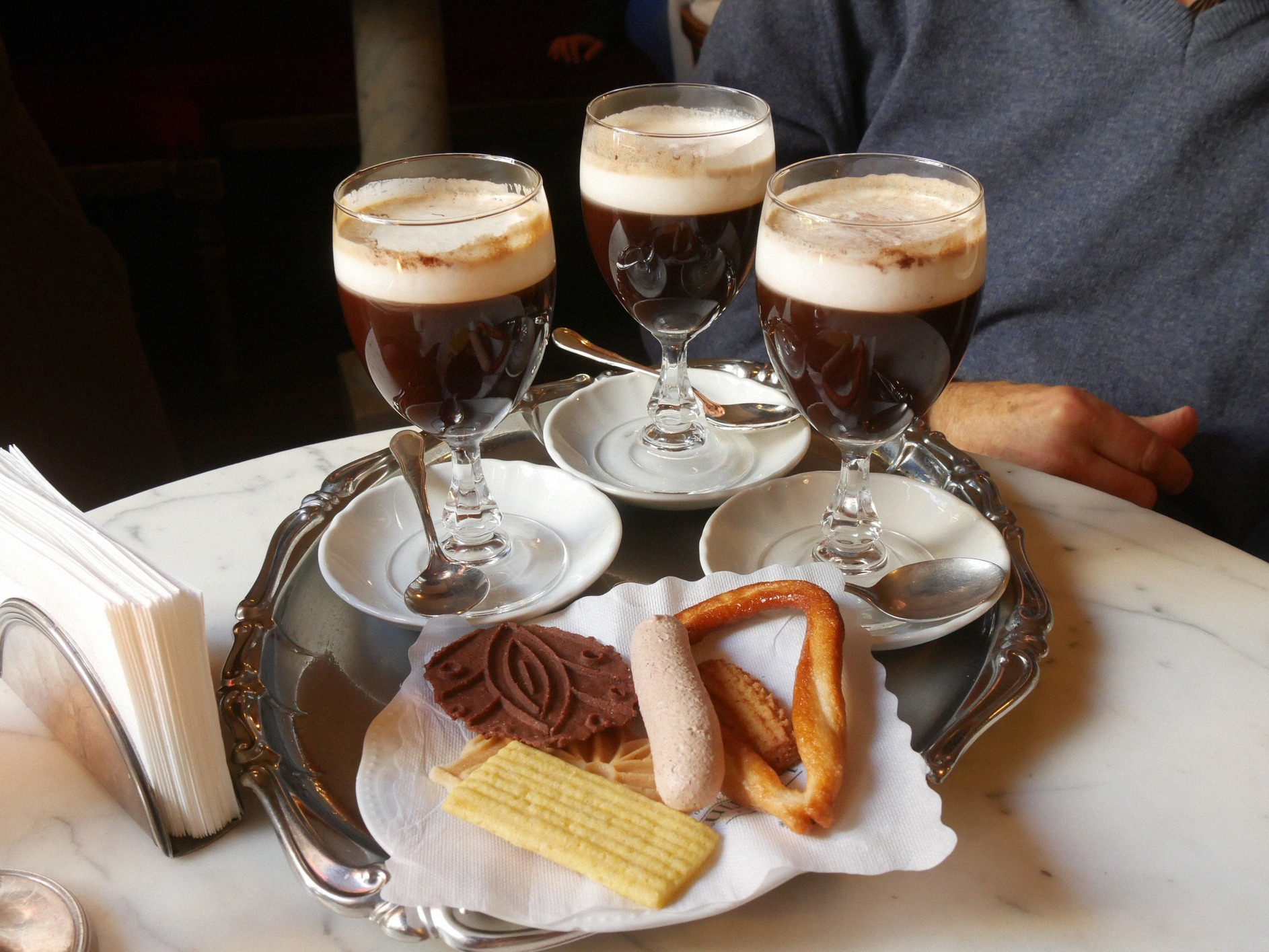
Turin's signature drink is the bicerin - Piedmontese for "little glass". It's made of three components: espresso (or coffee), melted hot chocolate, and a milk cream, layered in a small glass. Caffè Al Bicerin keeps the exact proportions of the original recipe secret.
Historically there were three versions - pur e fiur (coffee and milk foam, similar to a cappuccino), pur e barba (coffee and chocolate), and un po' di tut with all three ingredients. The last version won out, the bicerin as it's known today. At the café that gave it its name, it currently costs around 7 euros. For more on chocolate, gianduja and Piedmontese cuisine, see the Food & Drink guide.
Opening hours of the historic cafés
The four houses keep quite different hours, worth noting, since two of them close on Wednesdays.
- Caffè Al Bicerin: daily 9:00-19:15, closed Wednesdays. In 2026 several closures apply, a winter break from 12 to 16 January, a summer break from 29 July to 28 August, closed 22-24 June (the feast of St John), and closed on 25 December and 1 January.
- Caffè Mulassano: daily 7:30 to midnight, Friday and Saturday until 1:00, closed Wednesdays.
- Caffè Torino: Mon-Fri 7:30-24:00, Saturday and Sunday 8:00-24:00; breakfast from 7:30, plus lunch, dinner and aperitivo.
- Caffè San Carlo: seven days a week, 8:00-22:00.
A rule of thumb on pricing at the traditional cafés, table service is generally more expensive than standing at the bar. If you just want a quick espresso, you'll pay less standing at the counter; for the grand rooms, the mirrors and the view of the piazza, the table surcharge is really the point. Official espresso price lists aren't consistently published, so if you need exact figures, ask on the spot.
How aperitivo works
In Turin, aperitivo is less a quick drink than a ritual, the transition from the end of the working day into the evening. It typically runs from around 18:00 to 21:00; in the livelier nightlife districts, the aperitivo hour often doesn't start until around 19:00. On long summer evenings, it tends to feel later, simply because there's more daylight.
At its core is the apericena, the drink comes with access to the buffet. Typical items include olives, crisps, savoury snacks and salatini, taralli, crusty bread, tartine, cold cuts and salads, plus often hot dishes such as risotto, pasta or polenta. For many people in Turin, this stands in for dinner, and it usually costs around 10 to 15 euros. For the drink itself, the local choice is a vermouth or a Milano-Torino.
For something more refined, Caffè San Carlo has specific prices - Negroni 14 €, Americano 12 €, Milano-Torino al Barolo 13 €, Martini cocktail 15 €, tramezzini from 5 €; at lunchtime there's the Oggi a pranzo set menu for 12.50 €. At Caffè Torino and Mulassano, exact aperitivo and bicerin prices aren't officially listed, in terms of quality, the traditional houses sit at the upper end.
Where aperitivo happens in Turin
Aperitivo in Turin has clear addresses, depending on whether you're after elegant or lively.
- Centre / Quadrilatero Romano: the historic core between Piazza Statuto, Piazza Castello and Piazza San Carlo, within walking distance of all four historic cafés. Here, aperitivo blends with coffee-house atmosphere.
- San Salvario: Turin's aperitivo and apericena district par excellence, south of the centre near Porta Nuova station and Parco del Valentino. The liveliest streets are Via Saluzzo, Via Belfiore and Via Berthollet; the crowd skews under-30.
In practice: for a classic, calmer aperitivo, stay in the centre and pick one of the historic rooms; for buzz and a younger scene, head to San Salvario. You can combine both in one evening - a vermouth on Piazza San Carlo first, then move on. To plan the rest of your stay around it, see Day Trips from Turin and the Torino+Piemonte Card.